Children’s Bookshelf Safety in the UK What Every Parent Needs to Know
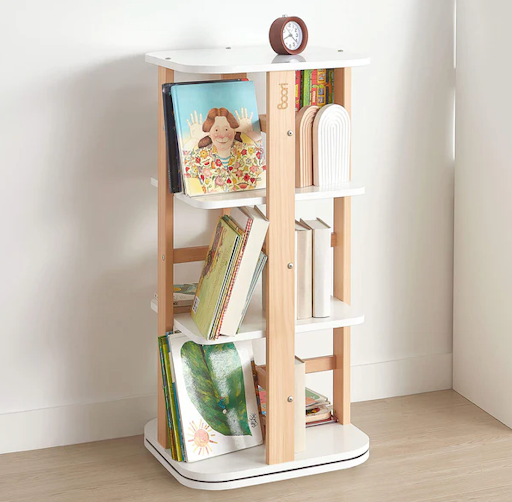
A children’s bookshelf in a UK bedroom is a piece of furniture that is loaded with heavy books, accessed multiple times a day by a child who may lean against it, pull on its shelves, and climb on its lower sections during enthusiastic browsing. The safety requirements for a bookshelf in a child’s unsupervised bedroom are therefore more stringent than those for an equivalent piece in an adult’s study or living room, and the consequences of a bookshelf failing those requirements, tipping, splintering, or exposing hardware, are more severe because the child is unsupervised when they occur. Understanding what makes a children’s bookshelf genuinely safe in a UK bedroom, and what questions to ask before purchasing any specific model, is the foundation for a confident and responsible purchase decision.
Key Takeaways
- Tipping prevention through correct wall anchoring is the most important single safety measure for any freestanding bookshelf in a UK child’s bedroom.
- The wall anchoring fixing must reach a wall stud or solid masonry, not just the plasterboard surface, which is inadequate to resist the lateral force of a tipping bookshelf.
- Non-toxic, lead-free finishes certified to international children’s furniture safety standards are required for any bookshelf in a child’s bedroom, not just an optional quality feature.
- All edges and corners on accessible surfaces must be rounded or bevelled, with no sharp points remaining after finishing or assembly.
- Panel thickness and join strength determine whether the bookshelf remains structurally sound under the combined weight of a full book collection and the lateral forces of a child browsing enthusiastically.
The Children’s Bookshelf Safety Checklist for UK Parents
| Safety Requirement | What to Confirm | How to Verify |
| Anti-tip anchoring | Wall anchoring provisions included as standard | Product spec and assembly instructions |
| Wall fixing type | Bracket reaches stud or solid masonry | UK wall construction check before fixing |
| Finish certification | Non-toxic, lead-free, certified to children’s standards | Product specification, explicit statement |
| Edge safety | Rounded or bevelled on all accessible surfaces | Product description and images |
| Panel thickness | Minimum 15 to 18 mm for structural integrity | Product specification |
| Back panel | Full-height back panel for rigidity | Product description and images |
| Shelf weight rating | Specified per shelf, adequate for books | Product specification |
Wall Anchoring The Most Important Safety Step
Why Bookshelves Tip Over
A freestanding bookshelf loaded with books has a centre of gravity significantly higher than an empty one. When a child leans against the bookshelf, pulls on a shelf edge for balance during browsing, or attempts to climb the lower shelves, a lateral force is applied to the top of the bookshelf. Without wall anchoring, this force can cause the bookshelf to tip forward, bringing the full weight of the books with it. The injury risk from a tipping bookshelf is serious, and incidents have been widely reported in UK households with freestanding furniture that was not correctly anchored.
How to Wall-Anchor a Children’s Bookshelf in a UK Home
The wall anchoring process for a children’s bookshelf in a UK home requires identifying whether the wall behind the bookshelf position is a solid wall (brick or blockwork), a studwork wall with a timber stud frame, or a dot-and-dab plastered wall with a cavity between the plasterboard and the structural wall behind. Solid walls and stud positions provide secure fixing points for the anti-tip bracket. Dot-and-dab plasterboard, without hitting a stud or solid wall behind it does not provide a secure fixing and must not be used as the sole anchor point for a bookshelf in a child’s bedroom.
Checking the Finish Safety
The finish on a children’s bookshelf in a UK bedroom should be explicitly stated in the product specification as non-toxic and lead-free, certified to the international safety standards for children’s furniture rather than to general furniture standards. This certification should be stated in the product description, not implied. A bookshelf described as having an ‘eco-friendly finish’ or a ‘water-based paint’ without explicit safety certification for children’s furniture does not meet the same standard as one with explicit children’s furniture certification.
For children’s bookshelves with explicit safety certification, wall anchoring provisions as standard, and construction built for the intensive use of a child’s bedroom, visit https://boori.co.uk/collections/bookshelvesand browse the Boori bookshelf collection.
Frequently Asked Questions
Are bookshelf anti-tip kits available separately for UK bookshelves?
Yes. Anti-tip furniture straps and L-bracket kits are available from UK hardware retailers and online suppliers as standalone safety products for any freestanding bookshelf. These can be used to anchor a bookshelf that did not include wall anchoring provisions in its original packaging. For bookshelves from quality children’s furniture brands, wall anchoring provisions are typically included as standard in the assembly hardware.
How do I find the studs in a UK plasterboard wall for anchoring?
A stud finder, available from UK hardware retailers for under ten pounds, detects the timber studs behind a plasterboard wall. In standard UK studwork construction, studs are typically at 400 or 600 millimetre centres. The stud positions do not always align conveniently with the bookshelf’s anti-tip bracket hole positions, which may require using a wall anchor appropriate for the specific wall type for off-stud positions.
What panel thickness is safe for a children’s bookshelf?
For a bookshelf loaded with children’s books, which includes heavy hardcover picture books, 15 to 18 millimetres of panel thickness is the appropriate minimum for shelves and side panels. Thinner panels, particularly at 12 millimetres or below, are more susceptible to bowing under the sustained weight of a full book load and to splitting at join points under lateral force.
Can a budget bookshelf be made safe for a UK child’s bedroom?
The non-toxic finish certification, rounded edges, and wall anchoring provisions can be added to or confirmed for any bookshelf before using it in a child’s bedroom. The one safety characteristic that cannot be retrofitted is panel and join quality: a bookshelf with thin panels and weak cam-lock-only joins cannot be structurally reinforced after purchase. For a bookshelf in a child’s bedroom, starting with https://boori.co.uk/collections/bookshelvesquality specifications rather than attempting to make a budget alternative safe is the more reliable approach.
Final Thoughts
Children’s bookshelf safety in a UK bedroom comes down to three non-negotiable requirements: correct wall anchoring to a solid fixing point, a non-toxic finish certified to children’s furniture standards, and construction quality adequate to handle the daily loading and lateral forces of a child’s active browsing use. These requirements should be confirmed before purchasing any bookshelf intended for a child’s unsupervised bedroom, regardless of brand or price point.