The Link Between a Child’s Bedroom Environment and Reading Habits
Children’s reading habits are shaped by many factors: the books available to them, the time adults spend reading with them, the reading modelled in the home, and the encouragement they receive from teachers and caregivers. One factor that receives less attention than it deserves is the physical environment of the bedroom itself. Where a child sleeps, plays, and spends their independent time is also where their most consistent and private reading happens. The design, organisation, and furniture of that room have a more direct effect on reading behaviour than is commonly recognised.
Key Takeaways
- The physical design of a child’s bedroom shapes reading behaviour by making books either more or less visible, accessible, and inviting at the moments when children have the most independent time.
- A bookshelf visible from the bed, positioned at the child’s natural eye level, increases the frequency of spontaneous book selection before sleep and after waking.
- A calm, uncluttered bedroom environment supports the focused attention that reading requires, while visually busy or disorganised rooms work against it.
- The reading corner, defined by a bookshelf, a comfortable seat, and good light, is the single most effective environmental intervention for building daily reading habits in young children.
- Children who have agency over their reading environment, including which books are displayed and how the reading corner is arranged, engage with it more consistently and independently.
How the Bedroom Environment Influences Reading
| Environmental Factor | Effect on Reading | How to Optimise |
| Book visibility | Visible books are selected more often | Front-facing display at eye level |
| Reading corner presence | Defined space increases reading time | Bookshelf plus seat plus lamp |
| Room clutter | Cluttered rooms reduce focused activity | Organised storage, minimal surfaces |
| Lighting quality | Poor light discourages evening reading | Dedicated reading lamp beside the seat |
| Proximity to bed | Nearby books support bedtime reading habit | Bookshelf within reach of sleeping position |
Visibility Is the Starting Point
The simplest and most consistent finding in research on children’s reading environments is that children read books they can see. A book on a front-facing shelf at eye level is selected regularly. The same book in a box, stacked in a pile, or visible only as a spine in a tightly packed bookcase, is functionally invisible for most children under eight. The implication is straightforward: the primary job of a bookshelf in a child’s bedroom is not to store books efficiently but to make books visible and inviting.
This is why front-facing display shelves, which show covers rather than spines, consistently outperform standard bookcases for children in the picture book and early reader years. Cover visibility is the trigger for selection, and selection is the prerequisite for reading. An environment that maximises cover visibility is one that generates more independent reading without any additional intervention from adults.
The Reading Corner as Environmental Anchor
A reading corner, even a very simple one, changes the bedroom environment in a way that no single piece of furniture can achieve alone. It creates a destination. When a child enters their bedroom during quiet time, and there is a clear, comfortable, well-lit reading spot, the choice to read is the path of least resistance. When there is no defined reading space, the child’s attention moves to whatever is most visually prominent and physically accessible, which is often not a book.
Building a reading corner requires a bookshelf positioned as the visual anchor, a comfortable seat immediately beside it, and a lamp that makes reading possible in the evening and on overcast days. The bookshelf does not need to be large. A low front-facing shelf holding 15 to 20 books is sufficient. The seat does not need to be elaborate. A floor cushion or a small rocking chair works as well as anything more expensive. The lamp can be a simple clip-on reading light. The combination of the three elements is what creates the destination.
Calm Over Stimulation
A bedroom that is visually calm, well-organised, and free of the constant demand for attention that screens and busy decor create is one that supports reading. A bedroom that is cluttered, visually noisy, or where screens are accessible and prominent is one that consistently pulls a child’s attention away from books. This is not a moral argument about screen time. It is a practical observation about how attention works in children’s environments.
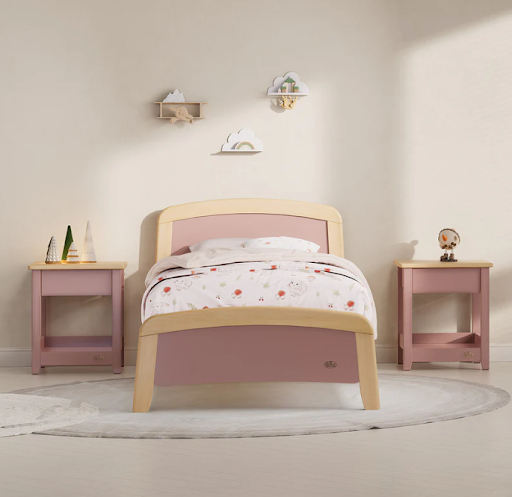
The furniture choices in a child’s bedroom contribute to its visual calm or its visual noise. Neutral-palette furniture with clean lines, organised storage that keeps toys and materials contained and out of sight when not in use, and a bookshelf that presents books clearly rather than adding to visual clutter all contribute to a bedroom environment that supports rather than undermines the reading habit.
Giving Children Agency Over Their Reading Environment
Children who have some control over their reading environment engage with it more consistently than children whose environment is entirely adult-determined. Agency in the reading environment includes: choosing which books are currently displayed on the shelf, deciding how the reading corner seat is positioned, selecting a new book for the rotation when old titles are cycled out, and having a say in where the reading lamp goes. None of these decisions are consequential in adult terms, but each gives the child a sense of ownership over the space that increases their investment in using it.
For a range of children’s bookshelves and bookcases designed to anchor a reading-friendly bedroom environment, visit
https://boori.com.au/collections/bookshelves-bookcases.
Frequently Asked Questions
Does the size of a child’s bedroom affect their reading habits?
Room size matters less than room organisation. Small bedrooms with a well-defined reading corner and a well-placed bookshelf produce reading habits as strong as large bedrooms with more space. The key variables are visibility, accessibility, and the presence of a dedicated reading spot, all of which are achievable in rooms of any size with appropriately chosen furniture.
At what age does the bedroom environment start affecting reading habits?
From around 12 months, when children begin to interact with books as objects and show preferences for specific titles. A low front-facing bookshelf introduced at this stage and a habit of regular book access before sleep creates environmental conditions that support reading from the earliest age at which it is developmentally relevant.
Should screens be removed from a child’s bedroom to support reading?
The relationship between screen access and reading time in children’s bedrooms is well-documented: children with screens in their bedrooms read less before sleep and during quiet time than children without them. Whether removing screens entirely is appropriate depends on the family’s broader approach to technology. Creating a reading-specific space that is physically and visually distinct from screen activity is a practical middle ground for many families.
How do I make reading feel special in a child’s bedroom without spending a lot?
A small personal lamp at the reading spot, a comfortable cushion in a colour the child chose, a special bookmark that belongs only to the reading corner, and a consistent daily reading time all create a sense of occasion around reading that costs very little. The physical environment need not be elaborate to feel special to a child. Consistency and intention matter more than expense.
Final Thoughts
The bedroom environment is not a background condition for children’s reading habits. It is an active participant in whether those habits form and how strong they become. A bookshelf the child can see from their bed, a reading corner they want to sit in, and a room that is calm enough to support focused attention are the three environmental conditions most directly within a parent’s control. Each is achievable with considered furniture choices and a modest investment of time in the arrangement of the room.